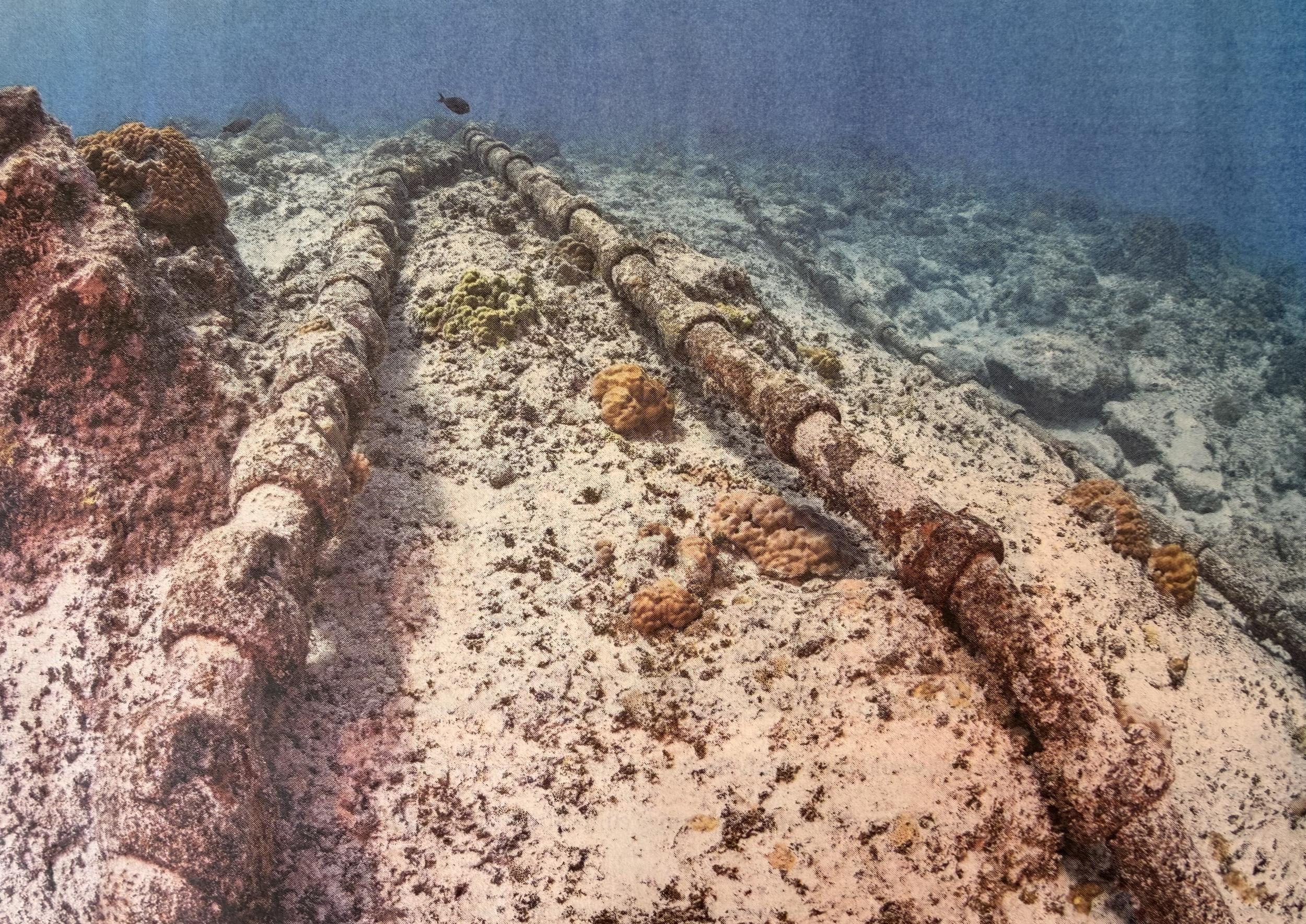
A telegram once felt almost miraculous. In 1858, a cable across the Atlantic let Queen Victoria and President James Buchanan exchange greetings without waiting for a ship to carry their words. The line failed within weeks. Engineers tried again, and a lasting link was established in 1866. By 1902, a cable network connected parts of the British Empire around the world. The "All-Red Line" was an instrument of commerce and power, planned around its routes and landing points. In the opening days of the First World War, Britain cut German transoceanic cables. The route a message takes has never been politically neutral.
This physical contest is the subject of two new books: Katja Bego's Deep Connections: The Hidden Battles to Control Subsea Cables, published by Polity this month, and Elisabeth Braw's forthcoming The Undersea War: The International Battle for Supremacy at the Bottom of the World. Bego describes her book as examining cable geopolitics, from the technology race to state power. Braw's publisher says her forthcoming book also covers subsea energy cables and pipelines. Both point to a timely issue. Neither book's title should make us treat every break as an act of war.
Today we talk about the cloud as if information floats free of geography. It does not. Data centres sit on land, draw power and exchange traffic through fibre. More than 99% of international data traffic runs through submarine telecommunications cables, according to the International Telecommunication Union. They are the main routes for a video call, bank instruction or government service crossing a border. A cloud service can be beautifully designed and still rely on a physical landing station, a power supply and a cable repair ship.
Cable faults are common without any hostile actor. The ITU reports roughly 150 to 200 a year worldwide. Fishing gear and dragged anchors are leading causes; earthquakes, underwater landslides, ageing equipment and abrasion also matter. Near shore, where ships and fishing boats work, cables are especially exposed. The question is whether a second route, enough capacity and a repair plan are ready when one fails.
Recent events show different forms of the problem. In March 2024, multiple failures off West Africa disrupted internet connectivity across several countries. Cloudflare also recorded problems reaching Microsoft Azure and Office 365 services. Damage at sea can be felt at a desk hundreds of miles inland. In the Red Sea that year, four communications cables were damaged; operator HGC said it rerouted traffic and estimated the cuts affected a quarter of traffic through that corridor. The cuts occurred amid attacks on shipping, but that does not establish their cause. Repair can be slower when ships cannot safely reach the site.
The Baltic has raised a harder security question. In late 2024, investigators found long anchor-drag marks near damaged power and telecommunications cables after the tanker Eagle S passed through. Other incidents prompted suspicion of deliberate interference. NATO launched Baltic Sentry in January 2025, adding ships, aircraft and other surveillance to protect undersea infrastructure. Yet suspicion is not a verdict: a Swedish prosecutor concluded that the Vezhen's January 2025 damage to a Sweden-Latvia cable was accidental, and a Swedish accident inquiry found no conclusive evidence that the Yi Peng 3 deliberately damaged two cables in November 2024. An anchor can be an accident, negligence or a weapon; evidence must decide which.
There is a genuine state-threat dimension nonetheless. In January 2025, the UK defence secretary said the Russian vessel Yantar was gathering intelligence and mapping critical underwater infrastructure near Britain. Monitoring a ship is not proof that it cut a cable. It is a reason to understand where critical routes converge, who can reach them and how quickly suspicious activity can be detected. Attribution matters, both to hold a perpetrator to account and to avoid escalating on the basis of rumour.
Islands and places with fewer routes are particularly exposed. When both main cables linking Taiwan's Matsu islands were broken in January 2025, Taiwan's digital ministry activated microwave backup and satellite capacity, prioritising government, banks and hospitals. It described the failure of one cable as likely related to ageing, not an attack. Taiwan's wider assessment identifies anchor damage near shore and natural hazards offshore. Geography, shipping patterns and a small number of landing points can matter as much as hostile intent.
Who pays when connectivity is lost? The obvious answer is network operators, but the effects spread. A payment may not settle; a trader may not see a price in time; a manufacturer may lose access to a supplier's system; a student or patient may be unable to reach a service; a family may not reach someone abroad. Governments and emergency responders need trusted communications. Disruption is rarely evenly shared. A densely connected country can often reroute, perhaps with slower service and higher cost. A remote community, an island or a smaller economy may have little spare capacity. One cut need not "take down the internet" to cause serious local harm.
Protection is therefore a matter of layers, not one naval patrol or one stronger cable. Map the routes and landing points on which essential services actually depend. Put genuinely separate paths in place, rather than buying two services that meet at the same beach or exchange. Bury and mark cables where appropriate, work with mariners and fishers, monitor vessel activity, and protect landing stations. Make repair agreements, spare parts and permits ready before a fault. Diversify with terrestrial, microwave or satellite links where they can carry the priority traffic, but test their real capacity. NATO's patrols and Taiwan's backups tackle different parts of the same problem; neither makes failure impossible.
Organisations need to ask a less comfortable question of their cloud providers and themselves. If a region, landing station or international route fails, where does the workload run, where is the data, and what does it cost in time and service to switch? Does an application require a foreign identity service to let a local worker sign in? Can staff keep a minimum service running with delayed data? A diagram of duplicate servers is not a test of the whole chain. Exercise the loss of a route, including payment, authentication, suppliers, customers and communications. Decide what must come back first.
The telegram became an email, a transaction and a video call. The physical dependency survived. We do not have to regard every damaged cable as sabotage, or pretend that more cables make us invulnerable. But we should stop describing digital life as weightless. Which links would your household, service or country miss first? And have you tried living without them for an afternoon, before the sea makes the choice for you?